
 Addlinker
Author
Addlinker
Author
Table of Contents
When you look at a backlink, the visible part is usually simple: a piece of clickable text pointing from one website to another.
Behind that link, however, there may be an HTML attribute that gives search engines additional context about why the link exists.
That is where terms such as dofollow, nofollow, and sponsored links come in.
For website owners, publishers, SEO professionals, and businesses using guest posts, understanding these link types is important. The difference is not simply about deciding which backlink is “better.” Each type of link can represent a different relationship between the publisher and the linked website.
Google’s current guidance focuses heavily on accurately qualifying links according to that relationship.
In this guide, we will explain how dofollow, nofollow, and sponsored links work, when each one is appropriate, how they apply to guest posting, and what businesses should check before evaluating a backlink opportunity.
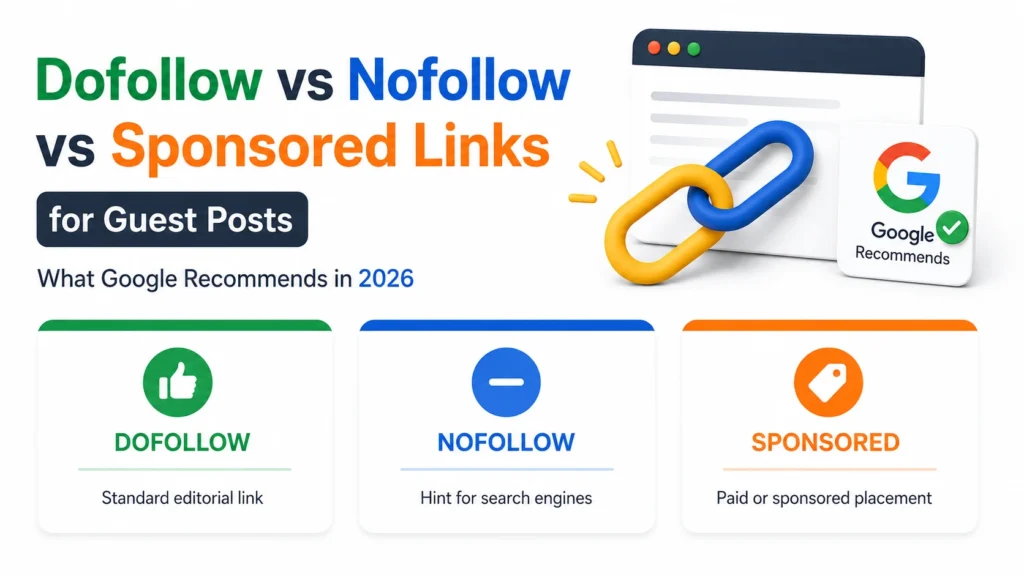
Quick Answer: Dofollow vs Nofollow vs Sponsored Links
Here is the simplest way to understand the three:
- Dofollow or follow link: A normal hyperlink without a qualifying nofollow, sponsored, or similar rel value.
- Nofollow link: A link containing rel=”nofollow”, generally used when the publisher does not want the link treated like a standard editorial endorsement.
- Sponsored link: A link containing rel=”sponsored” to identify advertising, sponsorships, paid placements, or other compensated relationships.
Google recommends marking paid links with rel=”sponsored”, although rel=”nofollow” remains acceptable for identifying paid links.
The important lesson is that a link attribute should describe why the link exists, rather than simply being selected because one attribute sounds more valuable for SEO.
What Is a Dofollow Link?
“Dofollow” is one of the most commonly used terms in SEO, but technically there is no HTML attribute called:
rel="dofollow"A normal hyperlink usually looks like this:
<a href="https://example.com/">Example Website</a>Because there is no qualifying rel value such as nofollow or sponsored, SEO professionals commonly refer to it as a dofollow link or followed link.
Search engines can process these standard links normally when discovering pages and understanding relationships between content across the web.
For example, imagine a marketing publication independently writes:
We tested several analytics platforms, and Example Analytics provided one of the easiest reporting dashboards to use.
If the publisher voluntarily chooses to link to the company as a useful resource and there is no commercial arrangement behind the link, a normal link may be completely appropriate.
Does a Dofollow Link Guarantee Better Rankings?
No.
A link attribute is only one part of a much larger SEO picture.
Google uses many systems and signals when evaluating pages. A dofollow link does not automatically make a website authoritative, nor does receiving one guarantee that a page will move higher in search results.
The source website, relevance of the page, quality of the content, placement context, anchor text, overall usefulness of the reference, and many other factors can matter.
This is why evaluating backlinks only by checking whether they are “dofollow” can give an incomplete picture.
What Is a Nofollow Link?
A nofollow link contains the following attribute:
rel="nofollow"For example:
<a href="https://example.com/" rel="nofollow">Example Website</a>The nofollow attribute gives Google additional information about how the publisher wants the link interpreted.
Google originally introduced nofollow years ago largely to help deal with link spam. Its treatment has since evolved.
Today, Google treats nofollow, sponsored, and ugc as hints rather than treating all of them as absolute instructions in every situation.
That distinction is important.
It means marketers should avoid oversimplified statements such as:
“Google completely ignores every nofollow link.”
That does not accurately describe Google’s current documentation.
At the same time, businesses should not acquire nofollow links expecting them to work like ordinary editorial links or relying on them for guaranteed ranking benefits.
Can Nofollow Links Still Be Valuable?
Yes, because a backlink can have value beyond direct ranking considerations.
A relevant nofollow link can potentially:
- Send referral visitors to your website.
- Introduce your brand to a new audience.
- Generate product or service discovery.
- Lead people to reference your research or resources elsewhere.
- Increase brand visibility within your industry.
- Help users navigate to useful supporting information.
Consider a business being mentioned by a major industry publication that applies nofollow attributes to external links as part of its editorial policy.
The referral exposure and credibility of that mention may still make it valuable to the business even though the link is qualified.
That is why judging every backlink exclusively by its rel attribute can be misleading.
What Is a Sponsored Link?
A sponsored link contains:
rel="sponsored"Example:
<a href="https://example.com/" rel="sponsored">Example Website</a>Google introduced the sponsored attribute to provide a clearer way of identifying links created because of a commercial relationship.
It can apply to situations involving:
- Paid articles.
- Sponsored content.
- Advertisements.
- Commercial placements.
- Affiliate relationships.
- Other forms of compensation connected to a link.
For advertising or paid placements, Google currently recommends rel=”sponsored”.
Google also states that nofollow continues to be an acceptable way of qualifying these links, although sponsored provides a more specific description of the relationship.
This distinction is particularly relevant to guest posting.
Dofollow vs Nofollow vs Sponsored: Side-by-Side Comparison
| Link Type | Typical HTML | Common Purpose | Commercial Relationship? |
|---|---|---|---|
| Standard / Dofollow | <a href=”URL”> | Ordinary editorial reference | Usually no |
| Nofollow | <a href=”URL” rel=”nofollow”> | Link without a standard endorsement | May or may not be |
| Sponsored | <a href=”URL” rel=”sponsored”> | Advertising or compensated placement | Yes |
| UGC | <a href=”URL” rel=”ugc”> | User-generated content | Usually user-created |
The table highlights something marketers sometimes miss:
The attributes describe relationships—not a simple quality score from best to worst.
A relevant sponsored placement on a respected publication and a random standard link on an unrelated low-quality page are completely different situations.
Looking only at the link attribute would miss most of that context.
What About rel=”ugc”?
Although this guide focuses mainly on dofollow, nofollow, and sponsored links, there is another important attribute worth knowing:
rel="ugc"UGC stands for User Generated Content.
Google recommends it for links appearing within user-created areas such as:
- Forum discussions.
- Comments.
- Community posts.
- Other user-submitted content.
For example:
<a href="https://example.com/" rel="ugc">Example Website</a>Publishers can also use more than one appropriate rel value when necessary.
For most professionally published guest articles, however, ugc is not the main attribute marketers will encounter.
What Does Google Recommend for Paid Guest Posts?
This is where the difference between the format of content and the reason the link exists becomes important.
A guest article itself is not automatically one specific type of link relationship.
Consider two different situations.
Scenario 1: Editorial Contribution
An industry publication invites an expert to contribute an article because the editor believes the person’s experience will benefit readers.
The author references an original study on their own website because it genuinely supports a statement in the article.
There is no payment, sponsorship, product exchange, or other compensation connected to the link.
That is fundamentally an editorial situation.
Scenario 2: Paid Placement
A business pays a publisher to publish an article that contains a link to the business.
Now there is a commercial relationship behind the placement.
Google’s guidance says links involving advertising or paid placements should be appropriately qualified. rel=”sponsored” is Google’s preferred attribute, while nofollow is also accepted for this purpose.
This is the distinction businesses and publishers need to understand.
The question should therefore not simply be:
Is this a guest post?
A better question is:
What is the relationship behind this particular link?
That question usually makes the appropriate link treatment much clearer.
Are Paid Links Always Against Google’s Guidelines?
There is considerable confusion around this question.
Commercial links exist everywhere on the web. Businesses advertise, publications sell sponsorships, creators use affiliate partnerships, and brands pay for exposure.
Google’s spam policies recognize that buying and selling links is part of the web economy for advertising and sponsorship purposes.
What matters is how those commercial links are handled.
Google states that paid links used for advertising or sponsorship purposes are not a violation when they are appropriately qualified with rel=”sponsored” or rel=”nofollow”.
The problem arises when compensated links are designed to manipulate Google’s ranking signals without appropriate qualification.
This is why transparency around link attributes matters for both advertisers and publishers.
Should Guest Posts Be Dofollow or Nofollow?
There is no universal answer because the correct choice depends on the relationship behind the link.
If a publisher independently chooses to reference a useful resource without compensation, a normal editorial link may be appropriate.
If the placement is compensated, Google’s current guidance calls for the link to be qualified using sponsored or nofollow, with sponsored being the more specific option.
There can also be publishers that use nofollow for certain outbound links as part of their own editorial policies.
Instead of asking whether every guest post should have one particular link type, evaluate the actual circumstances surrounding the placement.
Is Dofollow Always Better Than Nofollow?
This question is too broad to answer with a simple yes.
Imagine these two links:
Link A
A standard followed link appears on an unrelated website with thin content, very little audience relevance, and an article that barely relates to your business.
Link B
A relevant industry publication mentions your company in an article that your target customers actually read, but the publication applies a nofollow attribute to the link.
Which is better?
From a purely attribute-focused perspective, someone might immediately choose Link A.
From a broader marketing perspective, the answer becomes much less obvious.
Link B could potentially deliver:
- More relevant referral traffic.
- Better brand exposure.
- Qualified visitors.
- Industry recognition.
- New business opportunities.
- Future organic mentions.
The strongest backlink decisions therefore consider the entire placement, not just whether a link is followed.
8 Things to Check Before Evaluating a Guest Post Link
Whether you are earning an editorial mention or evaluating a placement opportunity, these factors can provide more context than link type alone.
1. Topical Relevance
Start with the relationship between the website, article, and destination page.
A link should make sense to someone actually reading the article.
For example, an accounting software company being referenced in an article about financial management for small businesses has a clear contextual relationship.
The same company being inserted into an unrelated article about gardening would be much harder to justify from a reader’s perspective.
A useful test is:
Would this reference still make sense if search engines did not exist?
If the answer is yes, the placement probably has stronger editorial logic.
2. Quality of the Actual Page
Do not evaluate only the domain.
Look at the article where the link will appear.
Ask:
- Is the content useful?
- Is it readable?
- Does it appear written for a real audience?
- Is the topic relevant?
- Are references added naturally?
- Does the article provide something beyond generic information?
A backlink exists on a page, not inside a DA or DR score.
3. Real Audience and Traffic
Traffic can provide another useful layer of context.
A website attracting real visitors within your target market may offer opportunities beyond SEO, including referral traffic and brand discovery.
Also look at geographic relevance.
A business primarily targeting customers in the United States may evaluate a publisher differently from a company trying to reach audiences in India, the United Kingdom, Australia, or multiple international markets.
4. Editorial Standards
Quality publishers generally have rules about what they accept.
They may review:
- Article quality.
- Claims and sources.
- Topic relevance.
- Promotional language.
- Link placement.
- Restricted industries.
- Author information.
- Formatting.
Editorial review can be a positive signal because the website is making decisions about what appears in front of its audience rather than automatically accepting everything submitted.
5. Link Context
Where a link appears matters to readers.
A contextual reference inside a relevant sentence is usually more useful than a link inserted without explanation.
Compare:
Businesses should regularly audit their website.
with:
Businesses conducting a technical audit can use this detailed website migration checklist to identify common redirect and indexing problems.
The second example explains why the reader may want to click.
That is better writing regardless of SEO.
6. Anchor Text
Anchor text should describe the destination naturally.
Avoid forcing the same commercial keyword into every placement.
Depending on the context, natural anchor text might include:
- A brand name.
- A website name.
- The title of a resource.
- A descriptive phrase.
- A URL.
- A naturally occurring keyword.
The goal should be clarity for readers, not mechanical repetition.
7. Link Attribute
Now check whether the link is:
- Standard/followed.
- Nofollow.
- Sponsored.
- UGC.
- Or using multiple appropriate values.
The attribute provides important context, but it should be evaluated alongside the other factors rather than in isolation.
8. Transparency of the Opportunity
Before proceeding with any publisher opportunity, understand what is actually being offered.
Important details may include:
- Website niche.
- Link type.
- Article requirements.
- Publishing guidelines.
- Estimated turnaround.
- Restricted categories.
- Traffic data.
- Third-party SEO metrics.
- Pricing.
Clear information makes it easier for businesses to evaluate whether a publisher fits their campaign objectives.
This is also the approach behind marketplaces such as AddLinker, where users can review publisher opportunities and compare available information such as website category, metrics, link type, and pricing before selecting a placement.
These data points should be treated as decision-making information rather than guarantees of search performance.
DA and DR Do Not Determine Whether a Link Is “Good”
Domain Authority (DA), Domain Rating (DR), and similar measurements can be useful when comparing websites, but they need context.
They are metrics created by third-party SEO platforms.
They are not Google’s internal ranking scores.
Google has specifically advised website owners to understand that third-party SEO tools do not have access to Google’s internal ranking data and cannot guarantee search performance.
This does not mean third-party metrics have no use.
They can be convenient research indicators.
But a smart evaluation should combine them with:
- Relevance.
- Organic traffic.
- Website history.
- Page quality.
- Audience.
- Editorial standards.
- Link placement.
- Link attributes.
Think of DA or DR as one data point—not the final verdict.
How to Check Whether a Link Is Dofollow, Nofollow, or Sponsored
You do not need advanced SEO software to check a single link.
Most desktop browsers allow you to inspect the HTML directly.
Method 1: Inspect the Link
- Open the webpage.
- Right-click the link.
- Select Inspect or Inspect Element.
- Find the <a> element.
- Look for its rel attribute.
Standard or “Dofollow”
<a href="https://example.com/">Example</a>No nofollow, sponsored, or ugc qualification appears.
Nofollow
<a href="https://example.com/" rel="nofollow">Example</a>Sponsored
<a href="https://example.com/" rel="sponsored">Example</a>UGC
<a href="https://example.com/" rel="ugc">Example</a>You may also encounter combinations such as:
rel="sponsored nofollow"Using multiple rel values is supported.
Common Link Attribute Mistakes
Mistake 1: Using rel=”dofollow”
You normally do not need:
rel="dofollow"“Dofollow” is SEO industry terminology rather than the special rel value required for a normal hyperlink.
A regular link generally needs no such qualification.
Mistake 2: Assuming Every Nofollow Link Is Worthless
A nofollow link may still send visitors, create brand awareness, generate leads, support discovery, or introduce your content to people who later reference it independently.
Measure marketing value, not just attributes.
Mistake 3: Treating Every Dofollow Link as High Quality
A standard link does not automatically become valuable because it lacks a nofollow attribute.
Relevance, context, audience, editorial quality, and the reason the link exists remain important.
Mistake 4: Leaving Compensated Links Unqualified
When a link exists because of advertising, sponsorship, or another compensated arrangement, publishers should follow Google’s guidance for qualifying commercial links.
Google prefers rel=”sponsored” for these situations, with nofollow remaining an acceptable alternative.
Mistake 5: Choosing Websites Only by DA or DR
A high third-party metric cannot tell you everything about a website.
Check the actual content, traffic, relevance, editorial standards, audience, and placement details before making a decision.
Mistake 6: Expecting Any Single Backlink to Guarantee Rankings
SEO does not work as a guaranteed exchange where obtaining one particular link produces a predetermined ranking increase.
Search performance depends on many factors, including the quality and usefulness of your own website.
Backlinks should therefore be part of a broader strategy that may include:
- Useful content.
- Technical SEO.
- Internal linking.
- Good page experience.
- Brand building.
- Digital PR.
- Search intent alignment.
- On-page optimization.
- Genuine audience development.
A Simple Decision Framework for Link Attributes
When you are unsure which link type applies, start with one question:
Why does this link exist?
Then use the relationship to guide the decision.
| Situation | Typical Treatment |
|---|---|
| Independent editorial citation | Standard link may be appropriate |
| Source/reference chosen naturally by publisher | Standard link may be appropriate |
| Paid guest post | sponsored preferred or nofollow |
| Sponsored article | sponsored preferred or nofollow |
| Advertisement | sponsored preferred or nofollow |
| Affiliate relationship | sponsored |
| Blog/forum comment | ugc or nofollow |
| User-submitted forum content | ugc |
| Publisher does not want to imply endorsement | nofollow |
This relationship-first approach is much more useful than trying to label every backlink as simply “good” or “bad.”
Building a Better Guest Posting Strategy in 2026
Modern guest posting should begin with the audience.
Before selecting a website, ask:
Does this publisher reach people who may genuinely care about my business, expertise, research, product, or content?
Then evaluate the quality of the website and proposed article.
A strong guest contribution should provide enough useful information that it would still deserve to be published even without the backlink.
That might include:
- Original insights.
- Practical instructions.
- Expert commentary.
- Industry experience.
- Useful examples.
- Research.
- Data.
- Case studies.
- Actionable recommendations.
The backlink should support the article rather than becoming the entire reason the article exists.
This approach aligns better with sustainable content marketing and produces something much more valuable for readers.
Where AddLinker Fits Into the Process
Finding suitable publishers individually can require considerable research.
Businesses may need to compare niches, website metrics, traffic, pricing, publishing conditions, link types, and other details before deciding whether a particular opportunity fits their campaign.
AddLinker helps bring publisher opportunities into one marketplace so users can research and compare available placements more efficiently.
However, the right placement will still depend on the campaign.
A local business may prioritize geographic and niche relevance.
A SaaS company might prioritize technology or business publications with the right audience.
An ecommerce brand may care more about product relevance and referral traffic.
And a digital PR campaign may prioritize authoritative editorial exposure and brand visibility.
There is no single metric that replaces thoughtful evaluation.
The objective is to find opportunities that make sense for the business, publisher, content, and audience while respecting the applicable search engine guidelines.
Final Thoughts
The difference between dofollow, nofollow, and sponsored links becomes much easier to understand when you stop viewing them as three levels of SEO value.
Instead, think of them as ways of providing context about a link.
A standard link is an ordinary hyperlink without special qualification.
nofollow provides additional context when the publisher does not want the link treated like a normal endorsement.
sponsored identifies links connected to advertising, sponsorship, paid placements, or other compensation.
And ugc helps identify links originating from user-generated content.
For businesses using guest posts, the most sustainable approach is not to chase a particular attribute at any cost.
Focus on relevant publishers, useful content, transparent placements, real audiences, natural context, and accurate link qualification.
That creates a stronger foundation not only for SEO, but also for referral traffic, brand visibility, credibility, and long-term digital marketing.
Frequently Asked Questions
Is a dofollow link the same as a normal link?
Generally, yes. “Dofollow” is SEO terminology used for a normal hyperlink that does not contain qualifying attributes such as nofollow, sponsored, or ugc. There is no requirement to add rel=”dofollow” to create a standard link.
Does Google recommend sponsored links for paid guest posts?
Google recommends using rel=”sponsored” for advertisements and paid placements. rel=”nofollow” is also accepted for qualifying paid links.
Are nofollow backlinks useless?
No. A nofollow backlink can still provide referral traffic, exposure, brand discovery, and other marketing benefits. Google also treats nofollow as a hint rather than an absolute directive. However, marketers should not assume a nofollow link will provide ranking credit.
Can a sponsored link still send traffic?
Yes. The sponsored attribute describes the relationship for search engines; it does not prevent users from clicking the link.
Is rel=”dofollow” required?
No. A standard hyperlink does not need a dofollow rel attribute.
What is the difference between sponsored and nofollow?
Sponsored specifically identifies a commercial or compensated relationship. Nofollow is broader and can be used when other rel values do not apply and the publisher does not want to treat the link as a standard endorsement. Google also continues to accept nofollow for paid links.
Should I avoid websites that provide nofollow links?
Not automatically. Consider the complete opportunity, including audience relevance, traffic, content quality, brand exposure, referral potential, editorial standards, and campaign objectives.
Does high DA or DR guarantee a high-quality backlink?
No. DA, DR, and similar scores are third-party metrics rather than Google ranking scores. They can assist with research, but should be considered alongside relevance, traffic, content quality, audience, and other factors.
Are paid backlinks allowed by Google?
Google recognizes paid links used for legitimate advertising and sponsorship. These commercial links should be appropriately qualified using rel=”sponsored” or rel=”nofollow”. Paid links intended to manipulate ranking signals without appropriate qualification can violate Google’s spam policies.
What should I check before choosing a guest post website?
Review the site’s topical relevance, actual content quality, audience, organic traffic, editorial standards, link context, available link attributes, publishing requirements, and overall suitability for your campaign rather than relying on a single metric.

Find relevant publisher websites in one place.
Compare real placement options by niche, SEO metrics, traffic and price before ordering.