
 Addlinker
Author
Addlinker
Author
Table of Contents
You built backlinks.
Some of them came from websites with decent traffic. Others have strong SEO metrics. A few may even be from well-known publications.
But weeks later, the page you wanted to improve is still sitting in roughly the same position.
At this point, the easiest conclusion is usually:
“I need more backlinks.”
That can be the wrong diagnosis.
Backlinks can help search engines discover pages, understand relationships across the web, and evaluate which pages may be useful for a search. Google confirms that link analysis and PageRank remain part of its core ranking systems, but links are only one part of a much larger system that evaluates many factors and signals.
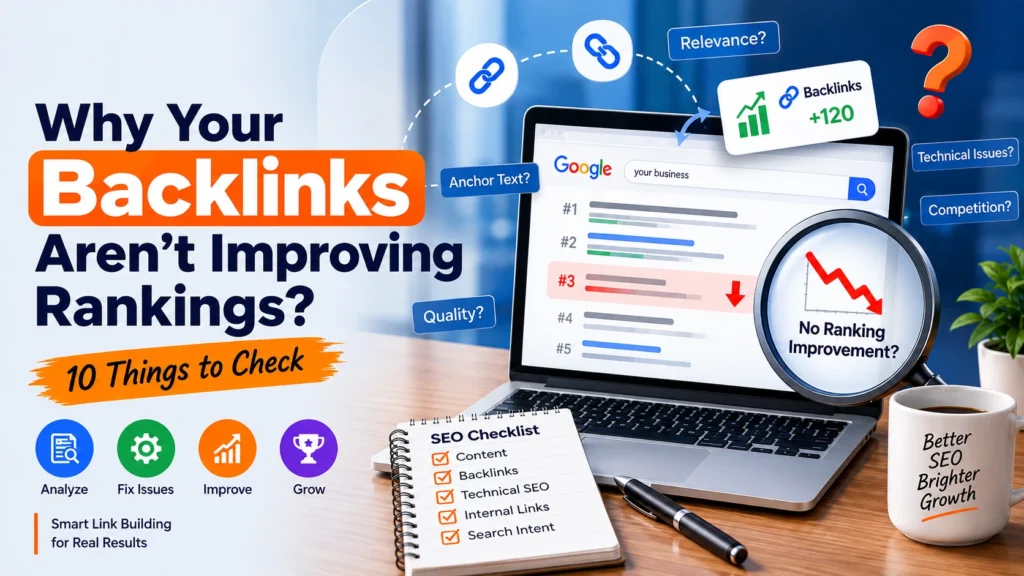
A page can have backlinks and still struggle because the real bottleneck is somewhere else: the destination page, search intent, relevance of the linking pages, technical SEO, internal linking, competition, or simply the way you are measuring progress.
Before spending more money or time building additional links, check these ten areas.
Quick Diagnostic: Where Is the Problem?
A useful way to diagnose backlink performance is to separate the problem into five layers:
| Layer | What to Check |
|---|---|
| The target page | Is the page actually strong enough to deserve the ranking you want? |
| The backlinks | Are the links relevant, contextual, accessible and appropriately qualified? |
| The website | Does your site support the target page through internal links, content and technical SEO? |
| The search results | Are you competing against pages that better satisfy the query? |
| Measurement | Are you expecting the wrong result or judging the campaign too early? |
This order matters.
If the page itself does not satisfy what searchers want, building another 50 links may not solve the underlying problem.
1. Your Target Page May Be the Real Problem
Backlinks cannot turn a weak page into the best answer for a search query.
Imagine that you are trying to rank a service page for a competitive keyword.
You build several relevant backlinks to it, but competing pages provide:
- clearer explanations,
- better examples,
- stronger trust information,
- more complete answers,
- useful comparisons,
- original data,
- better navigation,
- and a stronger overall user experience.
The backlink gap may not be your biggest problem.
The page-quality gap may be.
Does this page fully answer the searcher’s problem?
Do not evaluate it as the website owner. Evaluate it as someone who has never heard of your company.
Would that person understand:
- what the page offers,
- who it is for,
- how it works,
- what makes the information trustworthy,
- what they should do next,
- and whether their main questions have been answered?
If not, improve the destination before assuming the solution is simply more backlinks.
Check the actual search results too
Search your target query manually and look at the pages ranking well.
You are not doing this to copy them. Instead, identify what Google is currently interpreting as useful for that query.
For example, if most results are educational guides but you are trying to rank a short sales page, your problem may be search intent, not authority.
Links can strengthen a page. They cannot guarantee that an unsuitable page type becomes the best answer for a query.
2. Your Backlinks May Not Be Contextually Relevant
A backlink is not valuable simply because it exists.
Placement A
A cybersecurity company receives a link from an article about enterprise data protection on a technology publication.
Placement B
The same company receives a link from an unrelated lifestyle article where cybersecurity is mentioned only so the link can be inserted.
Both pages technically contain a backlink, but they do not provide the same context.
A useful backlink should make sense to the person reading the page.
If search engines did not exist, would this link still be useful here?
That simple question can eliminate many poor opportunities.
Relevance exists at several levels
- Domain relevance: Is the publication broadly connected to your market?
- Page relevance: Is the specific article related to your destination page?
- Paragraph relevance: Does the surrounding discussion naturally support the reference?
- Audience relevance: Are the people reading that publication likely to care about your topic?
A broad business publication can sometimes provide a more sensible placement than a highly specialized domain if the actual article and audience are relevant.
Context should be evaluated as a whole.
3. You May Be Judging Backlinks Mainly by DA or DR
DA, DR and similar scores are useful research metrics.
They are not Google’s ranking scores. Google’s guidance on third-party SEO tools and metrics makes clear that external SEO tools do not have access to Google’s internal ranking data.
This distinction matters because marketers sometimes build campaigns around a simple formula:
Higher DA = better backlink.
Real websites are more complicated than that.
Two domains with similar third-party authority scores can have completely different:
- organic visibility,
- traffic trends,
- editorial standards,
- audiences,
- content quality,
- topical focus,
- geographic reach,
- and publishing practices.
A metric should help you investigate a website. It should not replace the investigation.
What should you check alongside DA and DR?
- topical relevance,
- estimated organic traffic,
- traffic trend,
- ranking keywords,
- quality of recently published articles,
- audience country,
- editorial consistency,
- outgoing-link patterns,
- indexation of recent content,
- and whether the placement makes sense for your campaign.
If you are comparing publisher opportunities, using a marketplace that shows multiple data points together can make this research easier.
For example, AddLinker’s Guest Post Sites marketplace lets you compare available publishers using information such as DA, DR, monthly traffic, category, language, link type and price rather than relying on a single metric.
The important part is still the decision you make with that information.
No individual third-party metric guarantees search performance.
4. The Link Type May Not Be What You Think It Is
Not every clickable backlink represents the same relationship.
- a normal editorial link,
nofollow,sponsored,ugc,- or use more than one rel value.
These attributes provide search engines with information about the relationship behind the link.
This becomes especially important when money, sponsorship, advertising or another form of compensation is involved.
Google recommends qualifying paid placements using rel="sponsored", while nofollow remains an accepted alternative. You can review Google’s official outbound link qualification guidance and its link spam policy for the distinction.
That means a business should not evaluate a placement simply by asking:
“Is it dofollow?”
A better question is:
Why does this link exist, and how should that relationship be represented?
For a complete explanation, read our guide to dofollow vs nofollow vs sponsored links.
Also confirm that it is actually a crawlable link
Sometimes a page visually appears to link somewhere, but the implementation is unusual.
A standard crawlable web link generally uses an HTML anchor element with an href destination. Google’s link best practices explain crawlable links and descriptive anchor text in more detail.
If you are auditing an important backlink, inspect it. Do not assume that every button, JavaScript interaction, redirect or plain-text URL functions exactly like a normal hyperlink.
5. Your Anchor Text May Be Too Repetitive or Forced
Anchor text is the clickable wording used in a link.
Good anchor text helps people understand where the link leads.
Problems begin when link building becomes mechanical.
Suppose a company wants to rank for:
best accounting software for small businesses
If almost every external placement repeatedly uses that exact commercial phrase, the pattern can become repetitive and the writing itself often becomes awkward.
Natural references are much more varied.
- the brand name,
- the website name,
- the title of a resource,
- a descriptive phrase,
- a partial description,
- or the URL itself.
The goal should not be to invent a mathematical anchor-text ratio that supposedly “looks natural.”
The goal is much simpler:
Use wording that makes sense for the sentence and accurately describes the destination.
Read the sentence without thinking about SEO
Poor:
Businesses looking for BEST SMALL BUSINESS ACCOUNTING SOFTWARE can improve operations.
Better:
Businesses comparing platforms can review this small-business accounting guide before choosing a solution.
The second example explains why the resource is being referenced. That is better for the reader first.
6. You May Be Sending Links to the Wrong Page
Another common mistake is deciding that every backlink should point to the homepage.
Your homepage is important, but it is not always the page you want users or search engines to evaluate for a specific topic.
Imagine a website selling five different services.
If you want a detailed guide about email security to gain visibility, sending every relevant external link to the homepage may do little to strengthen the relationship between those references and the email-security resource.
The destination should make contextual sense.
Think at the page level
Which page deserves this reference?
- homepage,
- category page,
- service page,
- product page,
- research report,
- tool,
- case study,
- or informational guide.
A useful editorial link often points directly to the resource that supports the statement being made.
Do not force commercial pages into unrelated articles
If a publication is discussing industry statistics, linking to an original research report may be more logical than forcing a service-page link into the article.
That research can introduce the brand, attract relevant visitors and potentially create additional references over time.
Build the link around the content relationship—not around a rule that says every link must point to the money page.
7. Your Internal Linking May Be Undermining the Target Page
External backlinks get most of the attention.
Internal links are often treated as an afterthought.
That is a mistake.
Your website should clearly communicate which pages are important and how related topics connect.
Suppose you publish several articles about:
- guest posting,
- backlink quality,
- anchor text,
- DA and DR,
- link spam,
- and backlink audits.
If none of those articles links naturally to the others, you have created isolated pieces of content rather than a useful topic cluster.
Build relationships between related pages
A relevant article about backlink quality could link to:
- a DA vs DR guide,
- an anchor-text guide,
- a backlink-audit checklist,
- and a guide to link attributes.
The destination pages can then link back where useful.
This creates a logical path for both users and search engines.
Internal links should not be random
Do not add 30 internal links to every article simply because internal linking is good for SEO.
Link when the destination genuinely helps someone continue the topic. Use concise, descriptive anchor text.
The goal is to create an understandable website—not an internal-link maze.
8. A Technical or Indexing Issue May Be Holding the Page Back
Before blaming the backlinks, make sure the target page is technically eligible to perform.
Check whether the target page:
- returns a normal successful response,
- is accessible to search engines,
- does not accidentally contain
noindex, - uses the intended canonical URL,
- is not redirecting somewhere unexpected,
- is included naturally within your site structure,
- is mobile friendly,
- and can be rendered properly.
Google explains the broad discovery, crawling and indexing process in its How Google Search Works documentation.
Use Google Search Console’s URL Inspection tool for important pages.
Check the linking page too
If you are relying on a particular external placement, review whether that page is actually accessible and whether the link is present in the rendered page.
A backlink sitting on an inaccessible, removed or poorly implemented page is not the same as a stable editorial reference on a discoverable page.
Indexing and ranking are separate questions
A page can be indexed and still rank poorly.
Likewise, a sitemap can help search engines discover URLs, but it does not guarantee rankings.
Can Google access the page?
↓
Can Google index the page?
↓
Does the page appear relevant and useful for the query?
↓
Is it competitive enough to rank prominently?
This prevents you from trying to solve an indexing problem with more backlinks.
9. Your Competitors May Be Winning for Reasons Beyond Backlinks
SEO tools make competitor analysis look deceptively simple.
Your page has 25 referring domains. The competitor has 70.
“We need 45 more.”
That calculation ignores most of the search result.
A competing page might also have:
- stronger brand recognition,
- better content,
- more useful first-party data,
- better internal links,
- a longer history around the topic,
- stronger topical coverage,
- a better match for the search intent,
- more relevant mentions,
- or a better user experience.
Backlink count alone cannot explain every ranking difference.
Compare pages, not just numbers
- What problem does their page solve?
- What type of page is ranking?
- How detailed is it?
- What original value does it provide?
- Which related topics does the site cover?
- Where do its useful links come from?
- What is different about its search intent?
- What could your page do genuinely better?
The purpose of competitor research is not to recreate the same article with 500 extra words.
It is to understand what users currently have available—and identify what is still missing.
10. You May Be Measuring the Wrong Result—or Measuring Too Soon
The final problem may be expectations.
“A backlink moves rankings within exactly 14 days.”
There is no universal rule like that. Search engines need to discover and process pages and links, and ranking systems evaluate many signals.
Instead of asking only “Did my keyword move?”, measure a wider set of signals.
Check Search Console
- impressions,
- queries,
- clicks,
- average position,
- landing-page visibility,
- and the number of relevant searches showing the page.
A page may begin appearing for a wider range of queries before its primary keyword shows a dramatic movement.
Check analytics
- referral visitors,
- engaged sessions,
- conversions,
- assisted conversions,
- branded searches,
- and traffic to the linked page.
A placement that introduces qualified customers to your brand can have marketing value even when it does not create an obvious ranking jump.
Measure at sensible intervals
Instead, document:
- the publication date,
- target page,
- anchor text,
- source page,
- link attribute,
- campaign objective,
- Search Console baseline,
- and analytics baseline.
Then compare performance over meaningful periods.
Good SEO diagnosis requires evidence, not anxiety.
Before Building More Backlinks, Use This 10-Point Checklist
- Is the target page genuinely useful?
Does it satisfy the search intent better than—or differently from—the pages already ranking? - Are the backlinks contextually relevant?
Would the references make sense even without SEO considerations? - Are you relying too heavily on DA or DR?
Have you checked traffic, relevance, audience and actual content quality? - Do you understand the link relationship?
Is it standard, nofollow, sponsored or UGC, and is that treatment appropriate? - Is the anchor text natural and descriptive?
Or does the same commercial keyword appear repeatedly? - Are links pointing to the right destination?
Would a deeper resource make more sense than the homepage? - Does your internal linking support the page?
Can users naturally reach it from related articles and important site sections? - Is there a technical problem?
Check crawling, indexing, canonicalization, rendering and redirects. - Are you evaluating competitors beyond backlink counts?
Compare content, intent, topical coverage and overall usefulness. - Are you measuring correctly?
Track search visibility, traffic and business outcomes—not only one keyword position.
If you cannot confidently answer these ten questions, building more backlinks should probably not be your first move.
A Better Way to Think About Link Building
The most useful link-building question is not:
How many backlinks can I get?
It is:
What does this page need in order to become genuinely more useful, discoverable and credible for its intended audience?
Sometimes backlinks are part of that answer.
Sometimes the real priority is:
- rewriting the destination page,
- fixing indexing,
- improving internal links,
- publishing original research,
- matching search intent,
- strengthening topical coverage,
- earning industry exposure,
- or correcting an unfocused campaign.
Strong SEO campaigns connect these pieces instead of treating backlinks as an isolated product.
Where AddLinker Can Help
Researching publisher opportunities individually can take time.
You may need to compare website relevance, traffic, SEO metrics, language, category, link type, publishing requirements and price before deciding whether an opportunity makes sense for your campaign.
AddLinker’s Guest Post Sites marketplace lets you compare available publishers across multiple filters and data points before selecting a placement.
If you prefer a managed approach rather than choosing every publisher individually, you can also explore AddLinker’s Guest Posting Service.
And if the real bottleneck involves content, technical SEO, internal linking, keyword strategy or broader site performance rather than an individual placement, a more complete Monthly SEO Service may be more appropriate.
The purpose of these options is to help you choose the type of support that matches the diagnosis—not to promise that any individual backlink or service will produce a predetermined ranking result.
Final Thoughts
Backlinks still form part of how the web is connected, and Google’s ranking systems continue to use link analysis.
But that does not mean every link produces a measurable ranking increase.
If your rankings have stopped moving, resist the temptation to immediately increase link quantity.
Check the entire system: the page → the link → the website → the search results → the measurement.
You may discover that the problem has very little to do with how many backlinks you have.
And that is valuable information.
Because once you identify the real bottleneck, you can spend your SEO budget solving the right problem instead of simply repeating the same tactic.
Frequently Asked Questions
Why are my backlinks not improving my Google rankings?
There is no single reason. The target page may not satisfy search intent, the links may be contextually weak, technical issues may exist, competitors may provide stronger content, or the links may simply not contribute in the way you expected. Backlinks are one part of a broader ranking system.
Do more backlinks automatically mean higher rankings?
No. Link quantity alone does not guarantee rankings. Relevance, page quality, search intent, competition, link context, technical SEO and many other factors can affect search visibility.
How long should I wait before judging a backlink?
There is no universal timeframe. Crawling, indexing and ranking evaluation vary. Rather than expecting movement after a fixed number of days, establish a baseline in Search Console and analytics and monitor meaningful changes over time.
Does a high-DA backlink guarantee SEO improvement?
No. DA is a third-party metric, not Google’s internal ranking score. It can be useful for research, but should be considered alongside traffic, topical relevance, page quality, audience, editorial standards and other factors.
Can a nofollow backlink still be useful?
Yes. A nofollow link can still send relevant referral traffic, expose people to your brand and help users discover useful resources. Link attributes should be understood in the context of why the link exists.
Should backlinks point to the homepage or an inner page?
It depends on the context. Brand-level references may naturally point to a homepage, while links supporting a specific claim, service, study or resource may be more useful when they point directly to the relevant inner page.
Can internal links help a page that already has backlinks?
Internal links help users and search engines understand relationships between pages and can make important content easier to discover. Relevant internal linking should be considered alongside external links rather than treated as a separate afterthought.
Should I build more backlinks if my rankings have stopped moving?
Not automatically. First audit the target page, existing backlinks, internal links, technical setup, search intent and competitive landscape. Additional links make more sense after you understand what is actually limiting the page.
Are DA and DR Google ranking factors?
DA and DR are third-party SEO metrics. Google does not use those tool scores as its internal ranking metrics, and third-party tools do not have access to Google’s internal ranking data.
What should I check before choosing a guest post website?
Review topical relevance, actual page quality, audience, traffic, traffic trend, editorial standards, geographic fit, link context, publishing requirements and appropriate link attributes. Use DA and DR as supporting research data rather than the entire decision.
Related AddLinker Resources
- Dofollow vs Nofollow vs Sponsored Links for Guest Posts — understand how different link relationships should be represented.
- Browse Guest Post Sites — compare available publishers by multiple metrics and filters.
- Guest Posting Service — explore managed guest-post options.
- Monthly SEO Service — for broader SEO issues involving content, technical SEO and strategy.

Find relevant publisher websites in one place.
Compare real placement options by niche, SEO metrics, traffic and price before ordering.